Basic
$6.25 – $9.50
per sq ft installed · avg $7.75
Reference product
AquaGuard Sheyenne White Oak Waterproof Engineered Hardwood (7mm x 6.5in)
Price collected August 24, 2026
Flooring · Installed cost · 44 states
Engineered hardwood installation costs $6.25 to $15.25 per square foot installed, with a national average of $10.50 per square foot as of August 2026.
The band is built from May 2025 federal wage data for floor layers in your state, nine engineered-hardwood shelf prices collected in August 2026, and our own laying hours. Installed here means the plank, the crew's hours and the full-spread adhesive that bonds it down, all in one rate; tear-out, subfloor flattening, stairs and furniture are switches you add. In the 340 sq ft living room this page uses throughout, mid grade lands at $3,411: $10.03 a square foot.
Source: BLS OEWS May 2025 wages · retailer list prices dated August 24, 2026 · Sources & method →
National figures. 44 state-level areas are priced separately in section 15.
Compare this floor: vs Carpet · vs Hardwood · vs Vinyl Plank (LVP)
Live calculator · Area · Grade · State · Add-ons
Between 20 and 20,000 sq ft. Measure wall to wall, including closets.
Scales the labor half with BLS wage data (SOC 47-2042). Material prices are national.
Estimated total installed
$2,917 – $3,925
About $10.03 per sq ft · average $3,411
Average $3,411.
340 sq ft · Mid grade · National average
No add-ons selected
With the old floor out
The headline above does not include tear-out. One tap adds it.
Total = $2,265 material + $730 labor + $416 extras = $3,411
Same room, other grades
Nationally, 340 sq ft mid-grade engineered hardwood installation: $2,917–$3,925.
Check a bid
Got a quote? See where it lands.
Nothing is sent, stored or shared.
Our range is modeled for the settings above: it is not a quote. A bid outside it can still be right: tear-out, subfloor repair, stairs, access and material above the grades priced here all move a real number. Switch on what applies, then ask what else is in the price.
Data as of August 27, 2026 · Worked example · Methodology
Minimum job charge applies
A minimum job charge of $300 applies, so small jobs cost more per sq ft.
BLS OEWS May 2025 wages
The labor half is scaled by state from the federal wage release, SOC 47-2042.
Dated retailer list prices
Collected August 24, 2026; the three reference products are listed with their URLs under Sources & method.
Formula + worked example
The coefficients and the full arithmetic are in section 13.
Section 02
Choose the grade on the veneer and the core, not on the price tag. All three bands carry the same crew rate, so the whole distance between the cheapest and the dearest installed square foot is plank. And two boards that look alike can differ by a factor of five in how often the floor can be brought back.
$6.25 – $9.50
per sq ft installed · avg $7.75
Reference product
AquaGuard Sheyenne White Oak Waterproof Engineered Hardwood (7mm x 6.5in)
Price collected August 24, 2026
$8.50 – $11.50
per sq ft installed · avg $10.00
Reference product
allen + roth Provincial Hickory 1/2in x 5in Distressed Engineered Hardwood Flooring (38 sq ft/carton)
Price collected August 24, 2026
$11.00 – $15.25
per sq ft installed · avg $13.50
Reference product
CALI Barrel Cellar Door Oak 1/2in x 7.5in Engineered Hardwood Flooring (23.31 sq ft/carton)
Price collected August 24, 2026
All three bars share one scale, $6.25 to $15.25 per sq ft installed; the dot is the average. Source: retailer list prices (Floor & Decor, Lowe's), collected August 24, 2026.
How this number was captured
Each card names a reference product, its list price and its collection date. The figure is that grade installed: material from retailer list prices, labor from federal wage data and published labor hours, plus the extras in the breakdown. Details under Sources & method. Full listing in section 17.
| Grade | Pick it when |
|---|---|
| Basic | A turnover between tenants, or a floor you expect to swap out before it wears |
| Mid | It goes into bedrooms and living rooms of a house you live in |
| Premium | You want the thicker veneer, and mean to sand the floor one day |
Underneath, the money buys core: three plies at about 3/8 in in budget goods, five at about 1/2 in in the middle, seven or more at 5/8 to 3/4 in at the top HG-EH-Cost.
Those three shelf prices were collected at the dealer in August 2026, and the bands overlap in both directions: an expensive basic floor and a cheap mid-grade floor cost the same money our arithmetic. All three species are domestic mainstream, which is why our ceiling stays below guides that price teak.
On one manufacturer's terms, lifetime structural cover and 50 years on the finish arrive with a prorated remedy, a claim threshold of 10 percent of the floor, and finish cover that ends the moment the floor is sanded back Mohawk-TecWood-Warranty, which sits directly against the reason people pay for a thick veneer. Ask for the warranty document rather than the headline number before you buy into the top band.
Section 03
Match the veneer to how long you intend to keep the floor, because that one number decides whether you can ever refresh it. Products carry 0.5 mm to 6 mm of real wood on top; 2 mm is what budget product usually carries, on a plank measuring 10 to 14 mm in total WoodBeyond-WearLayer.
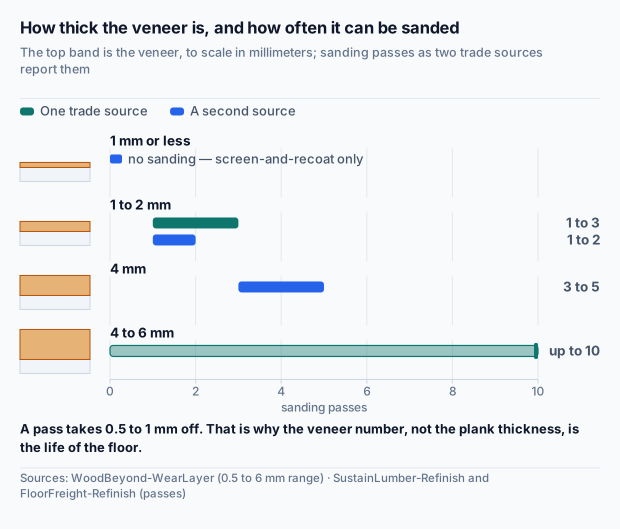
| Veneer on top | What it allows | Buy it for |
|---|---|---|
| 1 mm or less | no sanding at all; screen-and-recoat is the only refresh | a floor you will replace rather than renew |
| 1 to 2 mm | one to three passes over the life of the floor; at 2 mm, one to two, with a published life of 30 to 40 years | rentals, spare bedrooms, a tight budget |
| 4 mm | three to five passes, at about 0.5 to 1 mm of wood each time | the main floor of a house you plan to keep |
| 4 to 6 mm | sands repeatedly; at 6 mm, as many as ten times | a floor you want to sand the way you would sand solid wood |
The 1-to-2 mm and 4-to-6 mm rows SustainLumber-Refinish; the 1 mm, 2 mm and 4 mm figures FloorFreight-Refinish. Take the spec sheet rather than the category: a flat one to two sandings, the figure competing cost pages print for all engineered wood HG-EHvH, is right for a 2 mm board and wrong by a factor of five for a 6 mm one.
Under the finish sits a hardwood veneer, then a core of cross-laminated plies or high-density fiberboard, then a moisture-resistant backing that balances the face HG-EH-Cost. Alternating the grain cancels the seasonal movement that makes solid boards cup and gap, which is why this floor is allowed onto concrete, into a basement and over heat.
How the veneer was cut sets its ceiling. Sawn veneer comes off the log much as a solid board does, which allows the thickest wear layers. Sliced and rotary veneer typically arrive around 2 mm SolidWoodFlooringCo-Veneer. So if you want more than that, ask whether the veneer is sawn.
Screen-and-recoat is different work, and it belongs in the plan. A 220-grit pad takes off the coating and never reaches the veneer, so a thin board can still be refreshed, just not sanded FloorFreight-Refinish.
Section 04
Order to the allowance, then round up to whole cartons, because boxes do not split and a second delivery comes out of a different production run that may not match. The allowance is a property of the layout, not of the room.
How to measure the room, step by step (the guide is written for carpet; the length-times-width arithmetic is the same for any floor): How to Measure a Room for Carpet and Order the Right Amount.
| Your layout | Allowance on top | Order for this 340 sq ft room | Cartons of the premium board |
|---|---|---|---|
| Straight lay, wide or long boards | 10 to 15 percent | 374 to 391 sq ft | 17 |
| Diagonal | 15 percent or more | 391 sq ft and up | 17 or more |
| Herringbone or chevron | 17 percent | 398 sq ft | 18 |
| Herringbone specifically | 20 percent minimum | 408 sq ft | 18 |
| Herringbone in a small or irregular room | up to 25 percent | 425 sq ft | 19 |
Allowance figures Cavalieri-Waste-EH. The quantities and box counts beside them are ours, worked against the premium board's 23.31 sq ft carton our arithmetic.
The first row is the one buyers underestimate. Long wide planks get cut around defects more often than narrow ones, so a plain rectangle can still swallow a pattern-sized allowance Cavalieri-Waste-EH. Across a 1,000 sq ft floor that is 1,100 sq ft of plank at the mildest allowance and 1,250 at the harshest our arithmetic.
Then check the coverage printed on the carton, because it is not standardized. The market runs roughly 20 to 29 sq ft a box, with real listings at 28.5, 27 and 20.35 sq ft Greatmats-BoxContent. Our own reference boards sit outside that on both sides: 38 sq ft for the mid-grade product, 23.31 for the premium one, so a straight lay in this room is 10 to 11 boxes of the first and 17 of the second our arithmetic. Ask which allowance the dealer priced in, and how many cartons that comes to.
Section 05
Of the $10.50 national average, $7.11 is the plank itself, $2.16 is crew time and $1.23 is full-spread adhesive: 67.7, 20.6 and 11.7 percent of an installed square foot our arithmetic. The adhesive is the line that almost never reaches a bid under its own name.
What goes on the floor
The drawing is schematic: no layer thicknesses are measured in this data.
What the rate covers
What it does not
Four more things are chargeable and sit in the calculator as switches: taking up the old carpet, preparing the subfloor, wrapping a staircase and clearing the room. Turn them on to see what each adds to your own area. Subfloor preparation is the one to watch, at $1.67 to $10.00 per square foot, the widest band on this page, and the one nobody can price until the old floor is up.
Settle the disposal with the same switch. The national rate published for this floor stops short of both lifting the old floor and getting rid of it Homewyse-EH, so ask your installer whether the tear-out price ends at the curb or at the landfill, and get that answer onto the written quote.
This page prices a glued-down floor, so adjust before you compare. A floating quote drops the adhesive and picks up underlayment at $0.50 to $1.00 per sq ft HG-EH-Cost, or $0.39 to $0.69 for a cork product read on the maker's own site iCork-Underlayment. Have subfloor repair itemized as well: joists are put at $350 to $1,000 apiece and a full replacement at $900 to $3,000 Angi-EH, while repairing a 150 sq ft area is quoted at $250 to $750 Fixr-SubfloorReplacement.
Section 06
Get the method named on the quote before you compare two numbers. Engineered hardwood is the only wood floor that can be floated, glued or mechanically fastened, and the method changes the accessory list, the schedule and where the floor is allowed to go.
| Method | What the deck has to be | What it costs you | Choose it when |
|---|---|---|---|
| Floating (click-lock) | flat and firm: plywood, concrete, or an existing wood, vinyl or tile floor Bruce-Floating | the cheapest labor of the three HG-EH-Cost; no adhesive, but underlayment stops being optional Bruce-Floating | you want the DIY route or the shortest schedule |
| Staple-down | a wood deck reading no more than 14 percent moisture Mullican-Staple | fasteners only, and labor between the other two HG-EH-Cost | you have joists and plywood rather than a slab |
| Glue-down (priced here) | concrete or plywood, flat and tested | the dearest labor, for the preparation and moisture barriers around it HG-EH-Cost; $0.73 to $1.79 per sq ft of adhesive and up to 24 hours off the floor Wagner-EHConcrete | the floor sits on a slab, or the maker's instructions call for it |
Floating is the forgiving one. Boards lock to each other and float free of the subfloor, which is why the underlayment has to carry sound control, comfort and moisture protection by itself Bruce-Floating; one maker specifies foam no thicker than 1/8 in over a vapor barrier Mullican-Floating. Acclimation is short at 48 hours in the room Mullican-Floating, or 48 to 72 hours LWMountain-ClickInstall.
Whichever method you pick, hold the expansion gap. It equals the thickness of the material at every wall and vertical obstruction on a floating floor Mullican-Floating, and runs 1/2 in for 1/2 to 5/8 in stock BuildDirect-ExpansionGap. Trim covers that gap; it must not pinch it.
Section 07
Spend money here rather than on the board, because what is underneath is what usually pushed you toward engineered in the first place. Solid wood needs a sleeper build-up over a slab; engineered goes down on it directly HG-EHvH.
| Underneath | Methods it allows | What has to be true first |
|---|---|---|
| Concrete slab, any level | glue-down or floating | one maker's warranty conditions: internal humidity at 80 percent or below, or 3 lb of vapor per 1,000 sq ft in 24 hours Mohawk-TecWood-Warranty |
| Plywood or OSB over joists | staple-down, glue-down or floating | 13 percent moisture content on average, and 2 to 4 points between board and deck Wagner-EHConcrete |
| An existing wood, vinyl or tile floor | floating only, where it is flat and sound | carpet and badly damaged surfaces come out first Bruce-Floating |
| Radiant heat, under any of the above | as the layer above allows | never above 80 degrees F at the surface, no more than 3 degrees F of variation across the installed area, and a ceiling of 20 BTU per square foot per hour: a room needing more heat than that needs a second source to hold 70 degrees F NWFA-Installation-Guidelines-2025 |
Every row above also needs a flat deck. Over a 10 ft radius the surface may run out 3/16 in; across 6 ft, 1/8 in HFMag-EHConcrete. High spots get ground down and low spots filled: the adhesive under a plank was never meant to bridge either.
Ask to see the slab reading as a number, not as a reassurance. Method matters as much as result: one calibrated probe per 1,000 sq ft, and at least 24 hours for the drilled hole to settle before anyone writes a value down Wagner-EHConcrete. What counts as passing belongs to the product, so check the maker's own thresholds: one writes them into the warranty alongside 72 hours of acclimation at 60 to 80 degrees F Mohawk-TecWood-Warranty.
On radiant heat, run the system 7 to 14 days before the boards go down and hold it steady afterward; one maker caps its own product at 25 degrees C, and past the limit the wood dries into gapping, cracking and permanent damage Hallmark-RadiantGuide.
Section 08
Get the wood into the house before anyone opens a pail of adhesive: engineered planks want at least 48 hours in the room they will live in, and 72 where a manufacturer makes it a condition of coverage Mullican-Floating, Mohawk-TecWood-Warranty. That is far shorter than solid oak, and one reason this floor fits a renovation schedule.
Plan on 7.14 to 10.20 hours of installer time for the 340 sq ft default room, 8.67 in the middle. Laying is rarely what stretches a wood job: acclimation runs in front of it and curing behind it, with tear-out and subfloor repair ahead of both. A two-person crew is put at 500 to 1,000 sq ft a day, narrowed by one maker to 500 to 700 under ordinary conditions Hallmark-InstallSpeed.
Four mistakes account for most of the expensive callbacks:
Section 09
Take the room and the old carpet; attempt a click-lock floating floor if you have the weekends; hand over everything this page actually prices. Glue-down has a failure mode that only appears months later, which is why it belongs with a crew.
Switch the calculator to “I'll install it myself” for a materials-only figure: the labor line drops out and the minimum job charge no longer applies.
| Task | Do it yourself? | Why |
|---|---|---|
| Emptying the room yourself | Yes | The crew's furniture line comes off the bid |
| Pulling up the old carpet | Yes | Weekend work with a pry bar, and the tear-out switch comes off too |
| Click-lock floating in a square room | Yes, with time | No rented tool, and about half off professional work when it is done right Angi-EH |
| Glue-down of any kind | No | The wrong adhesive on a slab fails long after the crew has gone Wagner-EHConcrete |
| Stairs | No | Hand work, billed one tread at a time |
| Radiant heat, or an untested slab | No | The operating limits and the moisture number have to be settled first NWFA-Installation-Guidelines-2025 |
Budget the time honestly. One manufacturer puts a professional day at a room of roughly 170 to 215 sq ft, and a first-timer at two to three days for the same floor Hallmark-InstallSpeed. The tapping block is the easy part; jamb cuts, pipe collars and toe-kicks take the same minutes whoever holds the saw.
Section 10
Argue the plank, not the crew. Two thirds of an installed square foot here is board and a fifth is labor, so one step down the grade cards above saves more than any conversation about hours.
Six questions surface the differences that actually change a bid:
Take this with you
6 questions to ask before you sign
Then get tear-out, subfloor preparation and stairs written as their own lines rather than blended into one rate. Those three move most between two bids for the same room.
Section 11
Engineered hardwood is the cheapest way into a real wood floor, but it is not simply the cheaper wood floor: our band starts below solid hardwood and finishes above it. What usually decides is the subfloor, not the money.
| Floor | Installed, per sq ft | Choose it for |
|---|---|---|
| Engineered hardwood | $6.25–$15.25 | real wood on a slab, in a basement, or over radiant heat |
| Solid hardwood | $7.50–$14.50 | sanding measured in decades rather than in passes |
| Vinyl plank | $4.75–$13.25 | a core that shrugs off standing water |
| Carpet | $3.25–$14.75 | warmth, quiet and the cheapest way to cover a floor |
Standing water points to vinyl; generations of sanding point to solid; a slab, a basement or heat under the boards points here. The two side-by-sides, moisture limits and stair rates included, are on hardwood vs engineered hardwood and vinyl plank vs engineered hardwood. Everything else we price sits on the flooring cost hub.
Section 12
Two quotes for this exact room can sit $1,008 apart with nothing physical between them: 340 sq ft at one grade, in one size band, runs $2,917 to $3,925 our arithmetic. The gap is which board came out of the band and what a crew charges for its own time. The seven cards below name the drivers behind that gap, one at a time.
Price thickness apart from the veneer: $2 to $5 per sq ft at 5/16 in, $3 to $10 at 3/4 in, $5 to $15 at 7/8 in Angi-EH; more plies, less warping HG-EH-Cost.
Pick the species on looks: it moves the material line and nothing else: $2 to $6 per sq ft for bamboo and red oak, $9 to $13 for teak HG-EH-Cost.
Treat wide plank as marketing, not a spec: standard boards run 2 to 4 in, wide starts near 5 in, specialty reaches 14 to 16 in: no standards body defines it FCD-WidePlank.
Ask for tear-out on its own line, not inside the square-foot rate: switched on, it adds $0.70 to $1.60 a square foot of your own area.
adds $90-$170 per step
Get stairs quoted per tread, never folded into a square-foot rate: $90.00 to $170.00 a step here, or $1,170 to $2,210 over the 13-step run the box assumes our arithmetic.
Clear the room yourself and this line disappears; leave it to the crew and it is $25.00 to $75.00 for one room.
Expect your address to move the labor line only: about $2.11 per square foot from the cheapest state to the dearest, on the middle of the three lines in the rate our arithmetic.
Section 13
Full-spread adhesive is what makes this floor's arithmetic different from the other three we price. It is not an accessory here but a required line inside the extras term, worth $1.23 of the $10.50 average, while the plank alone is roughly two thirds and the crew's hours are the only part that answers to your address. Read the worked example below rather than a formula: it runs the 340 sq ft default room at mid grade through material, labor and extras and arrives at $3,410.73, or $10.03 per square foot. One thing it does not do is size your order: the area you enter is finished surface, and the allowance for waste comes on top of that. Percentile, waste factor, margin and the wage series behind each rate: how these numbers are built.
| Step | How it is computed | Result |
|---|---|---|
| Project size | 340 sq ft (default project size) | 340 sq ft |
| Size band | 340 sq ft falls into the 100–500 sq ft band | n/a |
| Material | $6.660915 per sq ft x 340 sq ft + $0.00 | $2,264.71 |
| Labor | (1 x $2.14623) per sq ft x 340 sq ft + (1 x $0.00) | $729.72 |
| Extras | ($1.224405 + 1 x $0) per sq ft x 340 sq ft + ($0.00 + 1 x $0.00) | $416.30 |
| Subtotal | $2,264.71 + $729.72 + $416.30 | $3,410.73 |
| Minimum job charge | max(0, $300.00 - $3,410.73) added to extras | $0.00 |
| Total (average) | $3,410.73 + $0.00 | $3,410.73 |
| Per sq ft | $3,410.73 / 340 sq ft | $10.03 |
Worked example: 340 sq ft, Engineered Hardwood - Mid grade, national average. Every figure here comes from the same calculation as the calculator above.
The coefficients behind those steps
total = material + labor × state index + extras
material = 6.660915 × area
labor    = 2.14623 × area
extras   = 1.224405 × areaCoefficients for Engineered Hardwood - Mid in size band 100–500 sq ft (340 sq ft), dollars per sq ft, published for 2026. A minimum job charge of $300 is added when the subtotal falls below it. State index 1.00 = national average.
How long the work takes
| Hours | Low | Mid | High |
|---|---|---|---|
| Per sq ft | 0.021 | 0.025 | 0.030 |
| On 340 sq ft | 7.14 h | 8.67 h | 10.20 h |
Drawn from 2 sources, listed in section 17.
How this number was captured
2 best-estimate sources set the hours above, medium confidence. Full record in section 17.
Section 14
Area is the weakest lever on this floor. Going from 200 sq ft to 2,000 sq ft moves the average rate only from $10.50 to $10.10 a square foot, because a size discount can reach labor and nothing else: the crew rate steps down at 100, 500 and 1,500 sq ft while plank and adhesive are billed flat, and plank is two thirds of the bill our arithmetic. Below the bands there is a floor rather than a discount: any total calculating under $300 is billed at $300, and the box will not accept an area under 20 sq ft.
| Project | Low | Average | High |
|---|---|---|---|
| 200 sq ft | $1,225 | $2,100 | $3,050 |
| 500 sq ft | $3,050 | $5,200 | $7,650 |
| 1,000 sq ft | $5,950 | $10,200 | $15,000 |
| 1,500 sq ft | $8,950 | $15,300 | $22,500 |
| 2,000 sq ft | $11,800 | $20,200 | $29,700 |
CostRule model. Totals include material, labor and extras.
| Room | Area, sq ft | Low | Average | High |
|---|---|---|---|---|
| 10×12 ft | 120 | $1,030 | $1,204 | $1,385 |
| 12×12 ft | 144 | $1,235 | $1,445 | $1,662 |
| 12×15 ft | 180 | $1,544 | $1,806 | $2,078 |
| 15×15 ft | 225 | $1,930 | $2,257 | $2,597 |
| 20×20 ft | 400 | $3,432 | $4,013 | $4,618 |
Default grade, national labor, no add-ons: pick your state and grade in the calculator. our arithmetic
Section 15
Between the cheapest and the dearest of the 44 states we can publish, this floor moves from $9.75 to $11.75 a square foot installed, two dollars, where the choice of board spans nine. Set your own state in the calculator before you read a bid: it rescales the crew's hours and leaves plank and adhesive alone. Seven state-level areas are missing from the table because no usable wage for floor layers is published there.
Pick your state in the calculator above: the labor line adjusts, material does not.
Lowest average · 4 states
$9.75
Alabama, Arkansas, Montana, Oklahoma
Highest average
$11.75
Alaska (AK)
Across all 44 states
$5.50 – $17.25
low to high per sq ft installed, May 2025 wages, SOC 47-2042
| State | Low | Average | High |
|---|---|---|---|
| Alabama AL | $5.50 | $9.75 | $14.25 |
| Alaska AK | $7.25 | $11.75 | $17.25 |
| Arizona AZ | $5.75 | $10.00 | $14.75 |
| Arkansas AR | $5.75 | $9.75 | $14.50 |
| California CA | $6.25 | $10.50 | $15.50 |
| Colorado CO | $5.75 | $10.00 | $14.75 |
| Connecticut CT | $5.75 | $10.00 | $14.75 |
| Florida FL | $6.25 | $10.50 | $15.25 |
| Georgia GA | $5.75 | $10.00 | $14.75 |
| Hawaii HI | $6.75 | $11.25 | $16.50 |
| Illinois IL | $6.50 | $11.00 | $16.00 |
| Indiana IN | $6.00 | $10.25 | $15.00 |
| Iowa IA | $6.00 | $10.25 | $15.25 |
| Kansas KS | $5.75 | $10.00 | $14.75 |
| Kentucky KY | $6.00 | $10.25 | $15.00 |
| Louisiana LA | $5.75 | $10.00 | $14.50 |
| Maine ME | $6.00 | $10.25 | $15.25 |
| Maryland MD | $6.00 | $10.00 | $14.75 |
| Massachusetts MA | $6.75 | $11.25 | $16.50 |
| Michigan MI | $5.75 | $10.00 | $14.75 |
| Minnesota MN | $6.25 | $10.50 | $15.50 |
| Mississippi MS | $6.00 | $10.25 | $15.00 |
| Missouri MO | $6.00 | $10.25 | $15.25 |
| Montana MT | $5.50 | $9.75 | $14.25 |
| Nevada NV | $6.25 | $10.50 | $15.50 |
| New Jersey NJ | $6.25 | $10.50 | $15.50 |
| New Mexico NM | $6.00 | $10.25 | $15.00 |
| New York NY | $6.25 | $10.50 | $15.50 |
| North Carolina NC | $6.00 | $10.25 | $15.00 |
| North Dakota ND | $6.00 | $10.00 | $14.75 |
| Ohio OH | $6.25 | $10.50 | $15.50 |
| Oklahoma OK | $5.50 | $9.75 | $14.25 |
| Oregon OR | $6.25 | $10.50 | $15.25 |
| Pennsylvania PA | $6.25 | $10.50 | $15.50 |
| South Carolina SC | $6.00 | $10.25 | $15.00 |
| South Dakota SD | $6.25 | $10.50 | $15.50 |
| Tennessee TN | $6.00 | $10.25 | $15.00 |
| Texas TX | $5.75 | $10.00 | $14.50 |
| Utah UT | $6.00 | $10.00 | $14.75 |
| Vermont VT | $6.00 | $10.25 | $15.00 |
| Virginia VA | $6.00 | $10.25 | $15.00 |
| Washington WA | $6.25 | $10.50 | $15.25 |
| West Virginia WV | $5.75 | $10.00 | $14.75 |
| Wisconsin WI | $6.00 | $10.25 | $15.25 |
BLS OES 47-2042, state-adjusted (May 2025). Only the labor term moves by state, and labor is 21% of the average total for this floor, so picking a state moves the average from $9.75 to $11.75 per sq ft, a spread of 21%. The material term stays at the national figure. It carries no local freight and no local dealer competition, and what that costs in accuracy is set out in the methodology. State figures cover 44 of 51 US state-level areas (the 50 states plus the District of Columbia). 7 are missing because the BLS Occupational Employment and Wage Statistics release (May 2025) does not publish a wage for SOC 47-2042 there: District of Columbia (DC), Delaware (DE), Idaho (ID), Nebraska (NE), New Hampshire (NH), Rhode Island (RI), Wyoming (WY). We leave those rows out rather than show a national figure in their place.
Download all 44 state figures as CSV or take the whole category in one file. Reuse is free with a link back, as stated in the terms.
How this number was captured
BLS Occupational Employment and Wage Statistics (OEWS), May 2025 release, SOC 47-2042, 44 states priced against the national average. Full record in section 17.
Section 16
10 questions, each answered with the figure it rests on and the source that figure comes from.
$10.50 per square foot installed as a national average, inside a band of $6.25 to $15.25, as of August 2026. Enter your own area, grade and state in the calculator before you set that against a bid: mid grade on the 340 sq ft default room works out to $10.03. One published calculator lands lower, at $7.89 to $12.79, but prices a floating floor rather than the glued one here Homewyse-EH. So check which method a cheaper number is buying.
Budget $5,950 to $15,000, averaging $10,200. Measure the rooms you actually intend to floor rather than the whole footprint, and remember the order sits 10 to 25 percent above the finished area Cavalieri-Waste-EH. A competing guide publishes $9,000 to $20,000 for the same job HG-EHvH; the distance is scope, because that band stretches to imported species our three reference boards never reach.
Twelve feet by twelve is 144 square feet, and mid grade puts that at about $1,445, with the grade band between $1,235 and $1,662 our arithmetic. The smallest row published on this page starts at 200 sq ft, so enter 144 in the calculator for a figure that fits your room. The crew rate does not step again anywhere between 100 sq ft and 500 sq ft, so a small bedroom is billed at the same $10.03 a square foot as a room three times its size.
Read the Lowe's number as a labor rate rather than an installed price. A supplier's cost guide puts its labor at $3 to $5 per square foot, bills removal of the old floor separately at $1 to $3, and reports no delivery or haul-away charge USABuilders-LowesLabor. Inside our $10.50 average the crew line is $2.16 and the plank itself $7.11, so a quote in that range is covering more than the laying. We publish no Home Depot figure for this floor.
Yes, as often as the veneer allows, so buy the thickness that matches your plan. A 4 to 6 mm layer sands repeatedly, and 6 mm takes it up to ten times; 1 to 2 mm allows only one to three passes SustainLumber-Refinish. At 1 mm or less, sanding is off the table and a screen-and-recoat is the only refresh FloorFreight-Refinish. Check the terms before you use it: on one product, sanding the floor back voids the finish cover Mohawk-TecWood-Warranty.
Yes, and it is the main practical reason to choose it over solid wood, which needs a sleeper build-up on a slab. Glue-down, floating and staple-down over a bonded plywood layer all work HG-EHvH. Two things come first: a documented slab reading under ASTM F2170 or ASTM F1869 before anything is bonded down Wagner-EHConcrete, and a plastic vapor retarder over the slab wherever the floor floats LWMountain-ClickInstall.
No, keep it out of rooms where water stands. It handles moisture far better than solid wood and is cleared for a basement, but the surface is real wood over a wood-based core, and only a handful of manufacturer lines claim to be fully waterproof Angi-EHvsLVP. Where a floor has to shed a leaking dishwasher rather than a spilled glass, vinyl plank is built waterproof from the core out.
Buy to the federal limit and have it named on the paperwork. Composite wood sold in the United States falls under the EPA rules made in TSCA Title VI, which cap formaldehyde emissions from hardwood plywood, medium-density fiberboard and particleboard, and from finished goods built on them (the core under an engineered veneer is exactly that) at limits identical to California's CARB Phase 2 EPA-TSCA-VI. Since June 1, 2018 boards made in or brought into the country have needed third-party certification from a certifier approved by CARB and recognized by EPA, and since March 22, 2019 that reciprocity has ended: the product itself has to be certified and labeled as TSCA Title VI compliant EPA-TSCA-VI. Ask for that wording on the carton and on the invoice before the order goes in, and treat a board that cannot show it as a board you do not know.
Only on a click-lock floating floor, and the reported saving is about half against professional work when it is done correctly Angi-EH. Glue-down (the method these figures price) is not a homeowner job, because the wrong adhesive on a slab fails months later as hollow spots Wagner-EHConcrete. Planks laid badly crack, cup or warp, and putting that right can outrun what a crew would have charged Angi-EH.
Plan on 20 to 40 years HG-EHvH and buy the veneer that matches that plan. Only one published figure is tied to a measured thickness: a 2 mm veneer at 30 to 40 years FloorFreight-Refinish. So ask for the wear layer in millimeters and treat the years as the output.
Section 17
Behind every number on this page: federal wage statistics for floor layers, national and by state, from the May 2025 release BLS OEWS May 2025; nine engineered hardwood shelf prices read at Floor & Decor and Lowe's on 24 August 2026; and two trade sources for laying time, consolidated at 0.021 to 0.030 man-hours per square foot, medium confidence CostRule-Model. How the three fit together is on how these numbers are built. Modeled ranges, not quotes.
37 sources behind this page: BLS wage data (May 2025) · 9 retailer listings across 2 retailers, checked Aug 2026 · 2 labor-hour sources · 32 standards, manufacturer pages and cost guides cited in the text.
The prices and wage figures the model runs on. The numbers in front of each entry are the ones the marks in the text point at.
Reference products (list prices read August 24, 2026)
The trade standards, manufacturer pages and competing cost guides the text names. The numbering runs on from the list above: a mark in the text carries the number of its entry here.
Data as of August 27, 2026. Wage release May 2025, SOC 47-2042, bls.gov, all data (ZIP).
Section 18