Basic
$7.50 – $11.25
per sq ft installed · avg $9.00
Reference product
Bruce Gunstock Red Oak Smooth Solid Hardwood Flooring, 3/4in x 2 1/4in
Price collected August 24, 2026
Flooring · Installed cost · 44 states
Solid hardwood flooring installation costs $7.50 to $14.50 per square foot installed, with a national average of $11.00 per square foot as of August 2026.
Installed means the boards, the paper and cleats under them and the crew's hours in one rate: tear-out, subfloor repair and site sanding are separate lines. Built from federal wage data, 22 solid-oak shelf prices and our own labor hours, the 340 sq ft living room here comes to $3,945 in mid-grade oak, or $11.60 per square foot.
Source: BLS OEWS May 2025 wages · retailer list prices dated August 24, 2026 · Sources & method →
National figures. 44 state-level areas are priced separately in section 15.
Compare this floor: vs Carpet · vs Engineered Hardwood · vs Vinyl Plank (LVP)
Live calculator · Area · Grade · State · Add-ons
Between 20 and 20,000 sq ft. Measure wall to wall, including closets.
Scales the labor half with BLS wage data (SOC 47-2042). Material prices are national.
Estimated total installed
$3,314 – $4,703
About $11.60 per sq ft · average $3,945
Average $3,945.
340 sq ft · Mid grade · National average
No add-ons selected
With the old floor out
The headline above does not include tear-out. One tap adds it.
Total = $3,072 material + $773 labor + $100 extras = $3,945
Same room, other grades
Nationally, 340 sq ft mid-grade hardwood flooring installation: $3,314–$4,703.
Check a bid
Got a quote? See where it lands.
Nothing is sent, stored or shared.
Our range is modeled for the settings above: it is not a quote. A bid outside it can still be right: tear-out, subfloor repair, stairs, access and material above the grades priced here all move a real number. Switch on what applies, then ask what else is in the price.
Data as of August 27, 2026 · Worked example · Methodology
Minimum job charge applies
A minimum job charge of $300 applies, so small jobs cost more per sq ft.
BLS OEWS May 2025 wages
The labor half is scaled by state from the federal wage release, SOC 47-2042.
Dated retailer list prices
Collected August 24, 2026; the three reference products are listed with their URLs under Sources & method.
Formula + worked example
The coefficients and the full arithmetic are in section 13.
Section 02
Decide the width and the surface first: those two, with the species, are what you pay for between the bands. The labor rate is identical in all three; every dollar between them is board.
$7.50 – $11.25
per sq ft installed · avg $9.00
Reference product
Bruce Gunstock Red Oak Smooth Solid Hardwood Flooring, 3/4in x 2 1/4in
Price collected August 24, 2026
$9.75 – $13.75
per sq ft installed · avg $11.50
Reference product
American Spirit Iceberg White Oak Smooth Solid Hardwood Flooring, 3/4in x 3in
Price collected August 24, 2026
$11.25 – $14.50
per sq ft installed · avg $12.75
Reference product
American Spirit Franklin White Oak Wire-Brushed Solid Hardwood Flooring, 3/4in x 5in (Wide Plank)
Price collected August 24, 2026
All three bars share one scale, $7.50 to $14.50 per sq ft installed; the dot is the average. Source: retailer list prices (Floor & Decor), collected August 24, 2026.
How this number was captured
Each card names a reference product, its list price and its collection date. The figure is that grade installed: material from retailer list prices, labor from federal wage data and published labor hours, plus the extras in the breakdown. Details under Sources & method. Full listing in section 17.
| Grade | Pick it when |
|---|---|
| Basic | A rental turnover, or a match to strip flooring already in the house |
| Mid | You want a wider, quieter board in rooms you plan to keep |
| Premium | Wide plank and texture are the point of the room |
The three reference boards behind those bands, read at Floor & Decor on 24 August 2026, run from a 2-1/4 in smooth red oak strip through a 3 in smooth white oak plank to a 5 in wire-brushed white oak plank. Band averages come out at $9.00, $11.50 and $12.75, and width alone carries a market premium climbing from $2 to $4 per square foot at 1 inch wide to $10 to $12 at 12 inches Fixr-Hardwood. Basic is the loosest band, $3.75 of spread on a $9.00 average against $3.25 on $12.75 in premium our arithmetic. The top of mid, $13.75, already sits above the premium average, which makes that last step a question of taste rather than money.
Buy prefinished unless you want a color no factory sells, or you are matching a floor already down. The finish arrives on the board, so the sanding and coating labor never reaches your invoice and the room is yours the day the last board is nailed. Factory aluminum-oxide coatings are among the most abrasion-resistant available DG-Bruce. Site finishing adds $3.00 to $8.00 per square foot and a calendar with it: waterborne coats carry light traffic after 24 to 48 hours and cure in 21 to 30 days, oil-based after 48 to 72 hours with 30 to 60 days to cure Resiners-Polyurethane. Dry enough for the next coat is not hard enough for a sofa leg.
Finish coverage is written per collection, not per brand. One maker covers the residential finish for 50 years on most collections, 15 years on builder-grade lines and 5 years in light commercial use Somerset-Warranty. Another runs from lifetime down to 5 years depending on the line, asks for 30 to 50 percent indoor humidity, and allows sanding one to three times Bruce-Warranty-official. Ask which collection is on the carton before you compare two quotes.
Section 03
Choose for movement and for the botanical name on the tag, not for a hardness number: the six species sold most often as solid flooring run from 1,010 to 1,880 lbf on the Janka scale, and price does not follow that order. Janka is the force needed to press a 0.444 in steel ball halfway into the wood at 12 percent moisture content.
| Species | Janka hardness (lbf) | Where it earns its place |
|---|---|---|
| Shagbark hickory | 1,880 | Entries, halls, dogs and children |
| Hard (sugar) maple | 1,450 | Traffic lanes and pale rooms |
| White oak | 1,350 | The wider boards on this page, and the one that moves more |
| White ash | 1,320 | An oak alternative with straighter grain |
| Red oak | 1,220 | The steadier oak, and the cheapest board here |
| Black walnut | 1,010 | Dark rooms, away from the path from the front door |
Hardness figures WoodDB-ShagbarkHickory, WoodDB-HardMaple, WoodDB-WhiteOak, WoodDB-WhiteAsh, WoodDB-RedOak, WoodDB-BlackWalnut. Only the two oaks carry a price on this page: red oak at $4.04 per square foot, white oak at $5.69 and $6.89, and species is the widest single lever on a board price.
Harder is not steadier. White oak is the harder of the two oaks and the one that moves more, at 5.6 percent radial and 10.5 percent tangential shrinkage against red oak's 4 and 8.6 WoodDB-WhiteOak, WoodDB-RedOak.
Buy on the botanical name. One published hardness table lists walnut at 3,680 lbf Fixr-Hardwood: a tropical species sold under the walnut name, not the domestic black walnut at 1,010 WoodDB-BlackWalnut. The sort on the carton is a separate question, and it is about looks rather than strength: every grade in the American standard carries the same structural quality, so a lower grade is not weaker wood H4L-NOFMA. What that costs you is board length and waste, which shows up in the quantity you order rather than on the price tag.
Section 04
Order the floor area plus an allowance, and order to the higher figure the moment the plan stops being a plain rectangle. Ordering short buys a second delivery that may no longer match; ordering long buys lumber that lives in the garage.
How to measure the room, step by step (the guide is written for carpet; the length-times-width arithmetic is the same for any floor): How to Measure a Room for Carpet and Order the Right Amount.
| Layout | Waste allowance | Order for a 340 sq ft room | Cartons at 23.5 sq ft |
|---|---|---|---|
| Straight lay, simple room | 5% | 357 sq ft | 16 |
| Straight lay, most projects | 10% | 374 sq ft | 16 |
| Straight lay, complicated plan | 12–15% | 381–391 sq ft | 17 |
| Diagonal | 15–20% | 391–408 sq ft | 17–18 |
| Herringbone, cut on site | 15–20% | 391–408 sq ft | 17–18 |
| Chevron, cut on site | 18–25% | 401–425 sq ft | 18–19 |
| Herringbone, factory modules | 10% | 374 sq ft | 16 |
Allowances Cavalieri-Waste, HD-Shaw-Solid-Install; factory modules PanTim-Waste; order quantities and carton counts our arithmetic. Chevron sits highest because every joint is an angled cut; factory modules sit lowest because they arrive assembled.
Add the sort on top of the layout. Number 2 common is expected to throw 12 to 15 percent waste before any pattern is considered H4L-NOFMA, and its average board runs 24 in against 36 in for clear NWFA-NOFMA-Unfinished.
Read the carton. Coverage is not standardized: boxes arrive at 18, 20, 23.5 and other square-foot counts depending on maker and board format HMP-BoxContent, so a rounded order rarely lands on a round number of boxes, and boxes do not split.
Fasteners follow board width, from 8,000 per 1,000 sq ft at 2 in wide down to 4,000 at 6 in Uptown-NailQty. Standard 2-1/4 in strip takes 7,200 per 1,000 sq ft, so the 340 sq ft room needs about 2,448 cleats, and a 1,000-count box covers roughly 139 sq ft our arithmetic.
Section 05
Boards take $8.45 of the average installed square foot, labor $2.25, and paper and cleats $0.29: the three lines behind the $11.00 national figure. A nailed solid floor is a short stack, which is why that third line stays so small.
What goes on the floor
Three layers, bottom to top: the subfloor underneath, a layer of rosin or felt paper, and solid hardwood planks nailed to the subfloor. The drawing is schematic: no layer thicknesses are measured in this data.
Included
There is no pad under a nailed solid floor, and none is priced here.
Billed on top. Six switches sit outside that rate, and the calculator above prices each of them: taking up an old hardwood floor, taking up carpet, sanding and finishing on site, subfloor preparation, stairs, and moving furniture. Two of them can outweigh the whole labor line on their own (site finishing at $3.00 to $8.00 and subfloor work at $2.20 to $10.00 per square foot), which is why a bid that folds either into one blended rate cannot be compared with anything.
Haul-away rides with the tear-out line, not with the floor. One national calculator puts removal and disposal of the existing floor outside its published rate Homewyse-HW, and a retailer's installation program bills taking the old floor up as its own item HomeyImp-Lowes. So when you switch tear-out on here, have the crew confirm that rate carries the dumpster and the tip fee rather than the pry bar alone.
Outside the model altogether: trim and transitions (thresholds $10 to $35 Fixr-Hardwood, shoe molding $1 to $3 per linear foot installed DG-ShoeMolding), plus permits, sales tax and the plywood build-up a concrete slab needs first.
Section 06
Book the delivery a week before the crew: oak sits in the room 3 to 5 days at normal indoor temperature and humidity before a nailer comes out, and some species take longer Mullican-NailDown. The nailing itself is short: roughly 7 to 11 person-hours on the 340 sq ft room here our arithmetic.
Clear the room including the closets, and settle who pulls the baseboards before anyone arrives.
Section 07
Solid hardwood is fastened to whatever is underneath it, so the deck is part of the floor rather than preparation for it. Better boards do not rescue a slab that fails a moisture test.
| What is under the floor | Nail down onto it? | What has to be true first |
|---|---|---|
| Plywood or OSB, joists 16 in on center | Yes | 19/32 in minimum, 23/32 in recommended DG-Plywood |
| Joists 19.2 in on center | Yes | 23/32 in panel DG-Plywood |
| Joists 24 in on center | Yes | 7/8 in single layer, or 3/4 in plus a 3/8 to 1/2 in overlay DG-Plywood |
| Concrete slab | Not directly | Sleepers or a plywood build-up, a polyethylene retarder, a deck to nail into; slab 30 days old and moisture-tested HWInfo-Concrete |
| Radiant-heated subfloor | Usually not | One guide excludes 3/4 in solid outright HD-Shaw-Solid-Install; where a collection allows it, hold the surface under 80 degrees F NWFA-Installation-Guidelines-2025 |
Flatness is measured, not eyeballed: a laser level, a taut string line or a straightedge. With mechanical fasteners of 1-1/2 in and longer the deck may run out by 3/16 in over 6 ft or 1/4 in over 10 ft; for glue-down, floating floors and shorter fasteners it tightens to 1/8 in over 6 ft and 3/16 in over 10 ft, and over concrete the tighter pair applies whatever the fastener NWFA-Installation-Guidelines-2025.
Over a slab, pick one system and follow it end to end: sleepers or a plywood build-up, not a mix of the two. Price that deck as its own line before a single board is bought, and expect the finished floor to rise 3/4 to 1-1/2 in Easiklip-ConcreteInstall: a door and threshold question as much as a cost one.
There is no one correct moisture content, because there is no one indoor climate: most of the country sits near 8 percent interior wood moisture, the dry southwest near 6, humid coastal regions near 11 NWFA-Installation-Guidelines-2025.
Section 08
Take the demolition and the furniture yourself; hand the nailer to a crew unless the room is an empty rectangle with nothing to cut around. The tool rents. The subfloor judgment does not.
Switch the calculator to “I'll install it myself” for a materials-only figure: the labor line drops out and the minimum job charge no longer applies.
| Task | Do it yourself? | Why |
|---|---|---|
| Pulling up the old floor | Yes | Worth $1.38 to $3.88 per sq ft on a wood floor, $0.70 to $1.60 on carpet |
| Moving furniture, pulling baseboards | Yes | Worth $25 to $75 a room, plus an evening on the trim |
| Nailing a plain rectangular room | Possible | One Alabama rental house lists a nailer at $51.90 a day RobinRents-Nailer; the skill is in the reading, not the trigger |
| Stairs, kitchens, bathrooms, open floors | No | Hand work and cuts around fixtures, where one wrong angle stays visible for the life of the floor |
| Subfloor repair | Only after you look | No one can quote it while the boards are still down |
Set whatever you save against the warranty before you commit: manufacturer cover is written around correct installation and a house held at 30 to 50 percent humidity afterwards Bruce-Warranty-official.
Section 09
Ask for the board line and the labor line separately, and settle scope before you collect bids. Most of the money is decided in the showroom rather than in the negotiation.
Five questions make two bids comparable:
Take this with you
5 questions to ask before you sign
Give this floor more calendar than crew: the boards wait in the room for days before a nailer comes out, and a site finish keeps working for weeks after the crew has gone. Prefinished product skips the last three rows of the table entirely, which is the strongest scheduling argument for buying it.
| Stage | How long | What decides it |
|---|---|---|
| Conditioning, acclimation and nailing | 7 days of HVAC before delivery HD-Shaw-Solid-Install, then 3 to 5 days of the boards resting in the room Mullican-NailDown, then 7 to 11 person-hours of nailing on this 340 sq ft room our arithmetic: the conditions behind each step are set out under "How does installation day go?" above | the season, the moisture readings and the room, not the calendar |
| Sanding and coating | ask your finisher for the coat schedule in writing; between coats the finish needs 2 to 4 hours waterborne or 8 to 24 hours oil-based Resiners-Polyurethane | site-finished floors only |
| Light traffic on a new finish | 24 to 48 hours waterborne, 48 to 72 hours oil-based Resiners-Polyurethane | which coating was quoted |
| Full cure | 21 to 30 days waterborne, 30 to 60 days oil-based Resiners-Polyurethane | the same coating, and nothing you can hurry |
Book the movers against the last row rather than the one above it if the floor is being finished on site. On a prefinished floor the three bottom rows disappear and the room is usable the day the nailing stops.
At mid grade the board rate alone runs $7.84 to $10.27 per square foot, a swing of $2.43 our arithmetic: larger than the entire average labor line, and a decision you make yourself. If solid wood is more floor than the budget wants, engineered hardwood prices at $6.25 to $15.25, vinyl plank at $4.75 to $13.25 and carpet at $3.25 to $14.75; the rest is on the flooring cost hub.
Section 10
Over joists, in a house you plan to keep, buy solid; over a slab, in a basement or with heat under the floor, buy engineered. Money rarely decides it: solid averages $11.00 per installed square foot against $10.50 for engineered, and the bands overlap almost completely at $7.50 to $14.50 against $6.25 to $15.25.
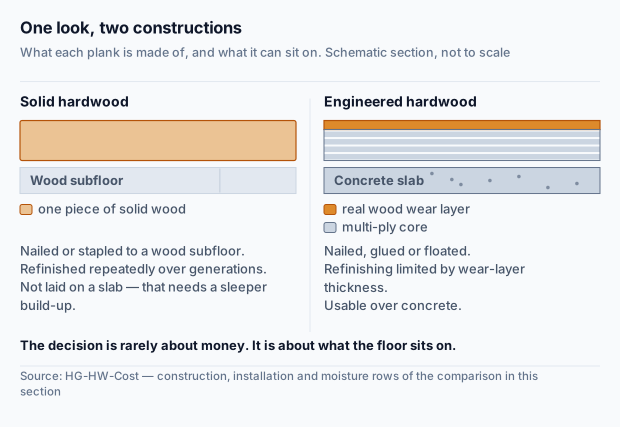
What separates them is what happens later. A solid board is one piece of wood, so it can be taken back to bare wood as long as material remains above the tongue; an engineered board carries a veneer that runs out. Solid is nailed or stapled to a wood subfloor, while engineered can be nailed, glued or floated, which is why manufacturers warrant it for conditions solid is excluded from HG-HW-Cost. The full side by side is on solid vs engineered hardwood.
Section 11
Plan on refinishing every 7 to 10 years at $2 to $8 per square foot, plus $0.50 to $2.00 if the floor is being stained HG-HW-Cost, against $11.00 per square foot to lay a new one.
Read the band rather than its middle, because it covers two different jobs. Eight dollars a square foot is a floor taken to bare wood and built back up in coats; two dollars is closer to a screen and recoat, which abrades the existing finish without reaching the wood. Ask which one a quote prices.
How often it can be done at all is set by two numbers worth knowing before you buy. A traditional sanding pass takes 1/32 to 1/16 in off the surface, and sanding is not recommended once less than 3/32 in of wear layer is left HFMag-SandCount. How many passes that leaves is a property of the board you buy: the timber over its tongue, not the full 3/4 in thickness. One warranty allows sanding one to three times depending on the collection Bruce-Warranty-official.
Section 12
Hold the room, the grade and the size band completely still and the model still spans $3,314 to $4,703 on 340 sq ft our arithmetic: nothing physical accounts for that, only which board was chosen inside the band and how a crew prices its own hours. The seven drivers below each carry a published price tag of their own.
Species moves the board line further than any other choice. Material alone runs $3 to $8 per square foot for pine and $11 to $20 for teak HG-HW-Cost.
Select and clear are quoted at $15 to $25 per square foot installed, against $9 to $13 for low grade Fixr-Hardwood. The sort is a price band of its own.
A herringbone floor is a different product, not a surcharge: $13 to $40 per square foot HG-HW-Cost, roughly 30 percent over a straight-laid floor Dedicated-Herringbone30.
Get tear-out itemized: the same work is published at $1 to $3 Fixr-Hardwood, $1.50 to $3.50 HG-HW-Cost and $1 to $5 per square foot NW-HW-Replace.
adds $100-$250 per step
Treads are quoted one at a time, never by area: $100 to $250 a step here, $1,300 to $3,250 for a 13-step flight. Published sets run $1,200 to $2,600 Fixr-Hardwood.
Nobody can price this until the old floor is up. Hold $2.20 to $10.00 per square foot in reserve; joist repair is billed separately at $350 to $1,000 each HG-HW-Cost.
Crews quote their labor at $3 to $6 per square foot, or $60 to $80 an hour Fixr-Hardwood, against $2.25 in the average installed square foot here.
Section 13
Wood is the category where the estimate leans hardest on material. In the worked example below (340 sq ft of mid-grade oak at national wages), $9.03 of the $11.60 square foot is board, $2.27 is crew time and $0.29 covers the paper and cleats a nail-down floor consumes. That mix is why moving the state selector barely moves the total. One thing the example cannot show: the area you enter is finished floor, not the lumber that leaves the store, and the waste allowance sits on top of it. Every step from a shelf price to a coefficient (percentiles, waste factor, margin, wage series) is written out on how these numbers are built. Nothing here is a quote; it is a model, worth what it tells you about a bid in your hand.
| Step | How it is computed | Result |
|---|---|---|
| Project size | 340 sq ft (default project size) | 340 sq ft |
| Size band | 340 sq ft falls into the 100–500 sq ft band | n/a |
| Material | $9.034515 per sq ft x 340 sq ft + $0.00 | $3,071.74 |
| Labor | (1 x $2.272478) per sq ft x 340 sq ft + (1 x $0.00) | $772.64 |
| Extras | ($0.294802 + 1 x $0) per sq ft x 340 sq ft + ($0.00 + 1 x $0.00) | $100.23 |
| Subtotal | $3,071.74 + $772.64 + $100.23 | $3,944.61 |
| Minimum job charge | max(0, $300.00 - $3,944.61) added to extras | $0.00 |
| Total (average) | $3,944.61 + $0.00 | $3,944.61 |
| Per sq ft | $3,944.61 / 340 sq ft | $11.60 |
Worked example: 340 sq ft, Solid Oak Hardwood - Mid grade, national average. Every figure here comes from the same calculation as the calculator above.
The coefficients behind those steps
total = material + labor × state index + extras
material = 9.034515 × area
labor    = 2.272478 × area
extras   = 0.294802 × areaCoefficients for Solid Oak Hardwood - Mid in size band 100–500 sq ft (340 sq ft), dollars per sq ft, published for 2026. A minimum job charge of $300 is added when the subtotal falls below it. State index 1.00 = national average.
How long the work takes
| Hours | Low | Mid | High |
|---|---|---|---|
| Per sq ft | 0.021 | 0.027 | 0.032 |
| On 340 sq ft | 7.14 h | 9.18 h | 10.88 h |
Drawn from 9 sources, listed in section 17.
How this number was captured
3 best-estimate sources set the hours above, high confidence. Full record in section 17.
Section 14
Ten times the floor buys almost no discount on wood: $2,200 at 200 sq ft against $21,500 at 2,000. Lumber is billed at the same rate whatever the room measures, so the crew's line is the only one that can step down: from $2.84 per square foot in the smallest band to $1.93 in the largest. If a bid drops sharply because the job got bigger, ask which line moved. The $300 minimum under the total rarely bites: a mid-grade job passes it at roughly 25 sq ft our arithmetic.
| Project | Low | Average | High |
|---|---|---|---|
| 200 sq ft | $1,500 | $2,200 | $2,900 |
| 500 sq ft | $3,750 | $5,550 | $7,300 |
| 1,000 sq ft | $7,350 | $10,900 | $14,200 |
| 1,500 sq ft | $11,000 | $16,300 | $21,400 |
| 2,000 sq ft | $14,600 | $21,500 | $28,200 |
CostRule model. Totals include material, labor and extras.
| Room | Area, sq ft | Low | Average | High |
|---|---|---|---|---|
| 10×12 ft | 120 | $1,170 | $1,392 | $1,660 |
| 12×12 ft | 144 | $1,404 | $1,671 | $1,992 |
| 12×15 ft | 180 | $1,755 | $2,088 | $2,490 |
| 15×15 ft | 225 | $2,193 | $2,610 | $3,113 |
| 20×20 ft | 400 | $3,899 | $4,641 | $5,533 |
Default grade, national labor, no add-ons: pick your state and grade in the calculator. our arithmetic
Section 15
State to state, the printed average for a solid oak floor moves $2.25 per square foot in total: $10.25 at the bottom of the 44-state table, $12.50 at the top our arithmetic, because three quarters of the bill is lumber priced the same everywhere. Choose your state in the calculator and watch the crew's line rather than the total; seven state-level areas have no row at all, because no wage is published for the trade there.
Pick your state in the calculator above: the labor line adjusts, material does not.
Lowest average · 2 states
$10.25
Montana, Oklahoma
Highest average
$12.50
Alaska (AK)
Across all 44 states
$7.00 – $16.75
low to high per sq ft installed, May 2025 wages, SOC 47-2042
| State | Low | Average | High |
|---|---|---|---|
| Alabama AL | $7.00 | $10.50 | $13.50 |
| Alaska AK | $8.50 | $12.50 | $16.75 |
| Arizona AZ | $7.25 | $10.50 | $14.00 |
| Arkansas AR | $7.00 | $10.50 | $13.75 |
| California CA | $7.75 | $11.25 | $14.75 |
| Colorado CO | $7.25 | $10.75 | $14.00 |
| Connecticut CT | $7.25 | $10.75 | $14.00 |
| Florida FL | $7.50 | $11.00 | $14.50 |
| Georgia GA | $7.25 | $10.75 | $14.00 |
| Hawaii HI | $8.25 | $12.00 | $15.75 |
| Illinois IL | $8.00 | $11.75 | $15.25 |
| Indiana IN | $7.25 | $10.75 | $14.25 |
| Iowa IA | $7.50 | $11.00 | $14.50 |
| Kansas KS | $7.25 | $10.75 | $14.00 |
| Kentucky KY | $7.25 | $10.75 | $14.25 |
| Louisiana LA | $7.00 | $10.50 | $13.75 |
| Maine ME | $7.50 | $11.00 | $14.50 |
| Maryland MD | $7.25 | $10.75 | $14.00 |
| Massachusetts MA | $8.25 | $12.00 | $15.75 |
| Michigan MI | $7.25 | $10.75 | $14.00 |
| Minnesota MN | $7.50 | $11.25 | $14.75 |
| Mississippi MS | $7.25 | $10.75 | $14.25 |
| Missouri MO | $7.50 | $11.00 | $14.50 |
| Montana MT | $7.00 | $10.25 | $13.50 |
| Nevada NV | $7.50 | $11.25 | $14.75 |
| New Jersey NJ | $7.75 | $11.25 | $14.75 |
| New Mexico NM | $7.25 | $10.75 | $14.25 |
| New York NY | $7.75 | $11.25 | $14.75 |
| North Carolina NC | $7.50 | $11.00 | $14.25 |
| North Dakota ND | $7.25 | $10.75 | $14.00 |
| Ohio OH | $7.50 | $11.25 | $14.75 |
| Oklahoma OK | $7.00 | $10.25 | $13.50 |
| Oregon OR | $7.50 | $11.00 | $14.50 |
| Pennsylvania PA | $7.75 | $11.25 | $14.75 |
| South Carolina SC | $7.25 | $10.75 | $14.25 |
| South Dakota SD | $7.50 | $11.25 | $14.75 |
| Tennessee TN | $7.25 | $10.75 | $14.25 |
| Texas TX | $7.25 | $10.50 | $13.75 |
| Utah UT | $7.25 | $10.75 | $14.00 |
| Vermont VT | $7.50 | $11.00 | $14.25 |
| Virginia VA | $7.25 | $10.75 | $14.25 |
| Washington WA | $7.50 | $11.00 | $14.50 |
| West Virginia WV | $7.25 | $10.75 | $14.00 |
| Wisconsin WI | $7.50 | $11.00 | $14.25 |
BLS OES 47-2042, state-adjusted (May 2025). Only the labor term moves by state, and labor is 20% of the average total for this floor, so picking a state moves the average from $10.25 to $12.50 per sq ft, a spread of 22%. The material term stays at the national figure. It carries no local freight and no local dealer competition, and what that costs in accuracy is set out in the methodology. State figures cover 44 of 51 US state-level areas (the 50 states plus the District of Columbia). 7 are missing because the BLS Occupational Employment and Wage Statistics release (May 2025) does not publish a wage for SOC 47-2042 there: District of Columbia (DC), Delaware (DE), Idaho (ID), Nebraska (NE), New Hampshire (NH), Rhode Island (RI), Wyoming (WY). We leave those rows out rather than show a national figure in their place.
Download all 44 state figures as CSV or take the whole category in one file. Reuse is free with a link back, as stated in the terms.
How this number was captured
BLS Occupational Employment and Wage Statistics (OEWS), May 2025 release, SOC 47-2042, 44 states priced against the national average. Full record in section 17.
Section 16
9 questions, each answered with the figure it rests on and the source that figure comes from.
Judge the scope before you judge the number. Mid-grade solid oak in a 340 sq ft room at national-average wages works out to $11.60 per square foot, inside a band of $7.50 to $14.50. Published bands sit higher: $9 to $23 per sq ft at one guide Fixr-Hardwood, $13.19 to $16.72 at a calculator dated May 2026 Homewyse-HW, and most of the distance is scope, because tear-out, subfloor repair and site finishing are separate lines here. Settle what each bid includes before you rank the rates.
$7,350 to $14,200 installed, averaging $10,900, with tear-out and site finishing switched off. One guide publishes $9,000 to $25,000 for the same area HG-HW-Cost; that band opens above our average because it prices exotic species, wide plank and pattern work, while all three bands here are solid oak. Match the species and the layout before you decide one of the two numbers is wrong.
About $1,671 at mid grade, roughly $1,404 to $1,992 across the band our arithmetic. Twelve by twelve feet is 144 sq ft, under the smallest row published here (200 sq ft at $1,500 to $2,900) and every room from 100 to 500 sq ft carries the same mid-grade rate of $11.60 per square foot. Order larger than the room: a plain rectangle takes 5 to 10 percent on top Cavalieri-Waste.
No. The headline range prices boards, rosin paper, cleats and the labor to install them. Switched on, removal adds $1.38 to $3.88 per square foot for old hardwood or $0.70 to $1.60 for carpet. Have it written as its own line at a stated rate rather than folded into a square-foot price: it is the line two bids most often differ on.
21 to 32 hours of laying, 27 in the middle case our arithmetic, from production rates of 0.021, 0.027 and 0.032 hours per square foot. Those are person-hours, not calendar days. Acclimation of 3 to 5 days comes first Mullican-NailDown, and a site-finished floor adds sanding plus coats with their own windows: light traffic after 24 to 48 hours on a waterborne finish, a full cure at 21 to 30 days Resiners-Polyurethane.
On paper yes, by a margin that shrinks fast. One worked comparison prices a 500 sq ft professional job at $3,500 against $1,950 done yourself: $1,500 of material, $150 of tool rental and $300 held back for mistakes, a saving of $1,550 Weles-DIYvsPro. Tool rental is the small line: one Alabama rental house lists a floor nailer at $51.90 a day RobinRents-Nailer, so price yours locally. Take the tear-out and the furniture yourself either way: that saving is certain and carries no warranty risk.
Secondhand figures put base labor at $2 to $5 per square foot, with another $1 to $3 for material, removal, subfloor prep or premium patterns, and $2,600 to $5,000 for a 500 sq ft project RemodelCalc-Lowes. The measuring appointment runs about $35, and taking up the old floor is billed separately HomeyImp-Lowes. Hold either quote against our 500 sq ft row ($3,750 to $7,300, average $5,550), which also excludes tear-out.
Appearance, and nothing else: both grades carry the same structural quality H4L-NOFMA. Select allows minimal color variation and knots up to about pencil-eraser size; #1 Common allows visible character and closed knots of 1 to 1-1/2 in. In oak the standard permits one small tight knot every 3 ft in Select NWFA-NOFMA-Unfinished. What the cheaper sort costs you is length: 32 in average boards against 28 in NWFA-NOFMA-Unfinished.
Do not budget on a resale figure. New wood flooring scores 8.8 for joy in the 2025 Remodeling Impact Report, which publishes no cost-recovery percentage for it and carries no refinishing category at all NAR-2025-RIR. Two often-quoted returns, 118 percent for a new floor and 147 percent for refinishing HG-HW-Cost, appear nowhere in it NAR-2025-RIR. What you can put a number on is keeping the floor: $2 to $8 per square foot every 7 to 10 years HG-HW-Cost.
Section 17
Every number above rests on three collections. May 2025 federal wage estimates for floor layers, occupation 47-2042 BLS OEWS May 2025. Twenty-two solid oak list prices gathered at Floor & Decor, LL Flooring and Lowe's in August 2026. And nine labor-hour sources, five of them government planning tables, the oldest published in 1971 TM5-551B. The chain from those three to the figures here is set out on how these numbers are built: modeled ranges, national and by state, not quotes.
53 sources behind this page: BLS wage data (May 2025) · 22 retailer listings across 3 retailers, checked Aug 2026 · 9 labor-hour sources · 40 standards, manufacturer pages and cost guides cited in the text.
The prices and wage figures the model runs on. The numbers in front of each entry are the ones the marks in the text point at.
Reference products (list prices read August 24, 2026)
The trade standards, manufacturer pages and competing cost guides the text names. The numbering runs on from the list above: a mark in the text carries the number of its entry here.
Data as of August 27, 2026. Wage release May 2025, SOC 47-2042, bls.gov, all data (ZIP).
Section 18